OctaMEDIC - OctaMED v4 clone for Linux/Mac/Win
US A Hand-coded Love Letter to a Classic Tracker 11/11/26OctaMED is a way of life for many of us - whether it's running the popular tracker software on original Amiga hardware or via emulation. But recently, a new clone of OctaMED v4 (arguably it's most popular incarnation) is being actively developed for modern Linux, Mac and Windows systems. I spoke to Amano Rosuko, a software developer from the Netherlands with a love for old hardware and software; the main developer behind OctaMEDIC.
Thanks for chatting to us! So Octamedic is a Clone Of OctaMED v4 for Linux/Mac/Win - what prompted you to specifically choose v4 of this classic Amiga program?
Despite being the more "limited" version of OctaMED, its extremely popular in the Jungle/DNB community I'm primarily a part of. Most people who want to use it have to spend a mortgage to get an Amiga, or go through the pain of setting up an emulator, which can be demotivating for some to enter this lovely world of old gear. Heavily inspired by the clone projects of "8bitbubsy", the creator of both PT2 clone and FT2 clone, I thought i'd give it a shot.
It looks like you've gone to town on details! Emulating Paula sound in PAL & NTSC; how important was authenticity of sound and workflow to you?
To me, this project wasn't meant to be a "replacement" of the real thing, I wanted this to be a sort of segue for people into the universe of old gear. For me backwards compatIbility was extremely important. If me and a mate want to create a track together, while they have an Amiga and i have my clone, I don't want us to be limited. So it was easier to do research into the Paula Chip and the Amiga Clock speeds to get it right than it would have been to just make some arbitrary playback engine. If a track doesnt sound the same in my clone as in a real Amiga, I feel like its not worth it.
True. Any modern quality of life improvements, not being limited to the original platform?
Yes, although backwards compatability is important to support the MED file format, that doesn't limit us to adding features to the actual application itself.
Some things we have on the radar as quality of life / extra features are advanced DSP functions in the sample editor (think of akai style timestretching, Eqing, Filtering etc) that get baked into the samples, meaning they stay backwards compatible. Also, to me it was important that people can make tracks start to finish in just the clone. So we support both rendering tracks as WAV, MP3, FLAC and also importing modern sample formats (WAV, MP3, FLAC) while still supporting the original raw and IFF file formats as well. For people that want to use external hardware, or just have some more routing capability, later on we will add a modification to the Paula chip emulation that allows the Paula channels to be sent to seperate outputs of your audio interface, so you can separate elements and send them into a mixer.
Later on, as a seperate project we will also make a DJ style player in the spirit of PT1210 to allow you to DJ using MED files.
Wow, that sounds cool! What's the development process like - what tools do you use, rust/python/C/AI? have you been able to make use of any existing codebases, or Amiga hardware documents?
Most of my open source products are written in Rust nowadays, although at work i mostly use C# and also prefer it, Rust makes it easier to make very small, fast and efficient programs while also having a ton of libraries that make prototyping very fast.
Regarding AI, I try to avoid it whever possible, only using it to document the code and document my findings in a more clear way for future contributors. I am not big on using AI to do the coding work however, as I get enjoyment from writing code and that would kind of defeat the purpose for me. When it comes to existing Amiga documents, when I initially started the project I used the open sourced File_Format.txt file shipped with the real OctaMED to figure out the storage format used. Then I made a small command line tool to parse and separate samples from them.
I got stuck for a while due to some real life stuff going on which demotivated me to continue, but after working on another tracker project of mine (mTrak) I found a pattern that worked for me. I ended up reusing alot of the code from that project for some of the simpler logic, but the most difficult part was to figure out the timings and pitches used by Amiga to make BPM, SPD and Transpose work properly. For this, I had to dissassemble some of the old .library files used by the real OctaMED, which was a bit easier to do this time around because I knew what I was looking for (alot of things are the same in Protracker's logic).
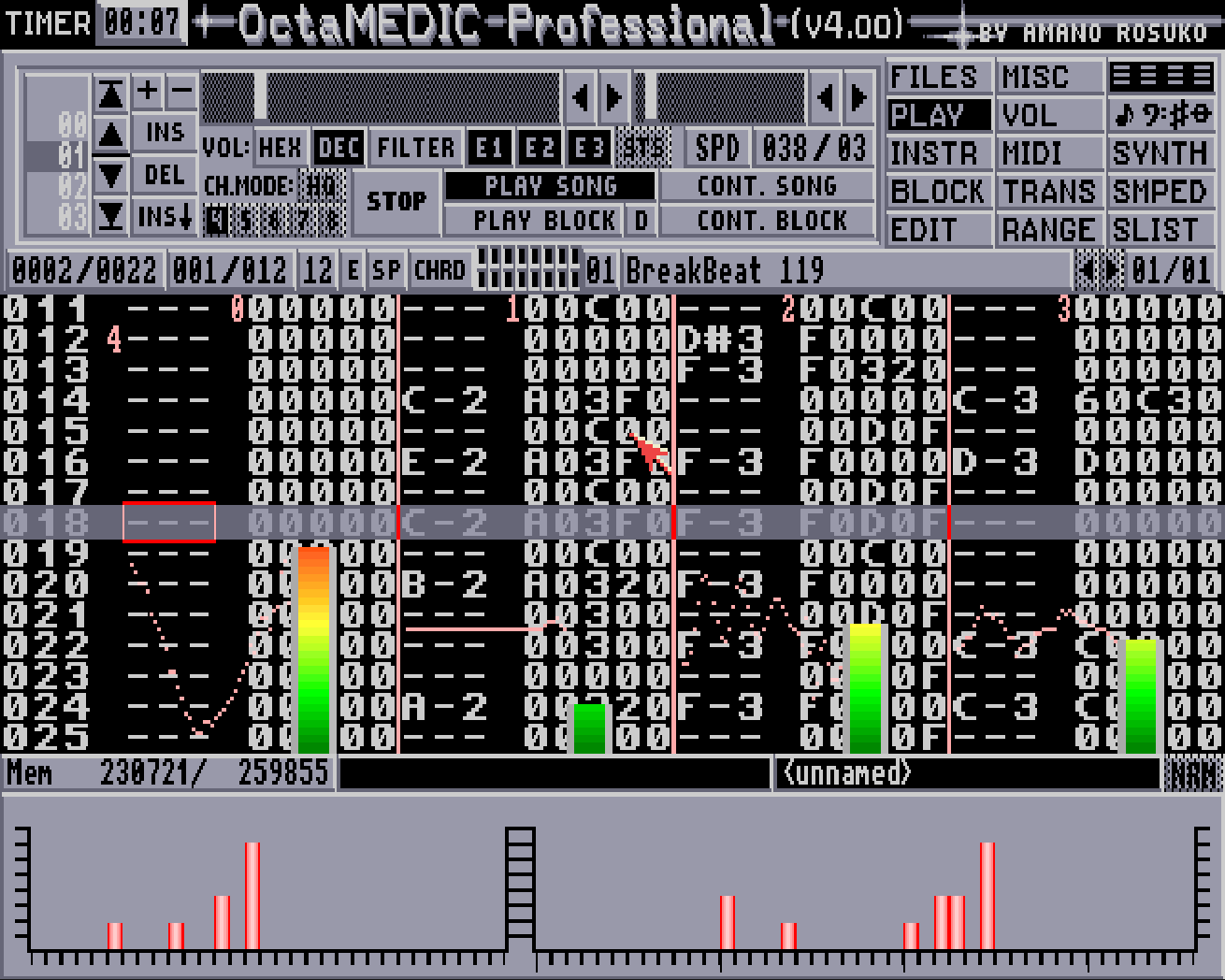
And what about testing the authenticity, what's your process?
For the features that exist in the real OctaMED, i spin up an emulator (don't have a real amiga sadly, although i am working to get one!) and put it side by side with the application, while comparing behaviours and sounds. I do one action in the real OctaMED, do it again in my clone, and if they dont match I make adjustments.
For the UI, I recreated the AmigaOS graphical library (its mostly just rectangles and borders) since that's what OctaMED also used for its UI; then i made a small script that can overlay a screenshot of my emulator on top of the clone, and detects all the pixels that dont align with the screenshot. After some filtering of texts and fonts that don't matter much, I can then get the boxes, sliders and buttons in the right position.
Why do you think OctaMED, and Amiga music software in general, still captivates so many people's imaginations today?
Completely biased in my own opinion: I think it's the simplicity. I used to make music in a DAW where you have 100000s of effects and vsts, can place down a million tracks and channels and it becomes very easy to want to do too much. With this old software/hardware, the limitations make workflows very simple (not easy!) which makes you use your creativity in a unique way to overcome those limitations.
Completely agreed! Where can our readers go to find out more about OctaMEDIC?
I have recently made a Discord server where i post updates, patch notes and do general conversing with the community about the project:
https://discord.com/invite/cjAQR9xB5q (TrackerCatz)
I also frequently post on r/TrackerMusic and in the TRACKERS facebook group.
To download, test and contribute to OctaMEDIC; the github (open source and community maintained) is the place: https://github.com/TheExiledCat/octamedic
Posted by MagicalSynthAdventure an expert in synthesis technology from last Century and Amiga enthusiast.Get the latest headlines, offers and more in our great sonicstate newsletter - delivered to your in box every week
More News: Like This
- ttiimmee: Turn Signals into Grain Clouds 10-Nov-26
- Mefjus Studio Insights 10-Nov-26
- Free ReBirth RB-338 Clone Released 09-Nov-26
- Mr. Scruff & His Most Iconic Track 09-Nov-26
- Arca on Music, Sound Design and Workflow 06-Nov-26
Even more news...
Get Our Newsletter
More...
Featured Video
Worthy of a point release
 September Member Discounts - u-he Bazille and Cherry DS-2
Savings of 30% on these and more
 5 Minutes With Behringer 2-XM Sem Clone
With Chris from Boo Electric
 Funniest Reviews from the SonicState Archives: AKAI pt1.
It's Flat-out Grime Time!
 SonicLAB: Knobula Drum Farm
Eurorack Drum synth and samplers
 IMFMSynth - 8 Operator FM Synth Interview
An Interview with Creator, Kaito Sato
 Broke Beats pt1 - A £37 Interface & Multi FX
Livtra Nanocore


