An Xpansive Interview: ACME XP60
US A chat with creator Markus Malik 15/01/26
|
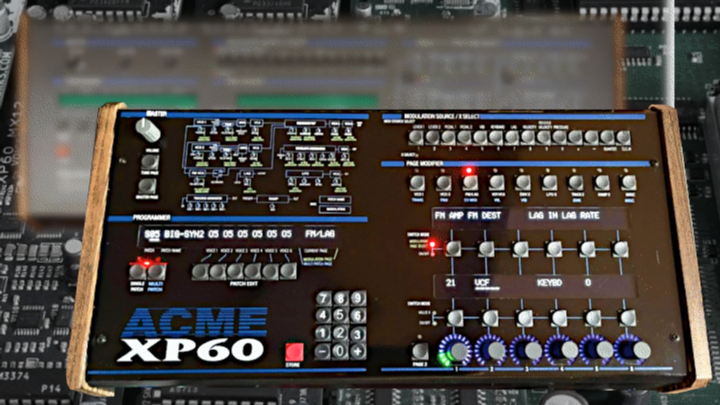
The ACME XP60 is a modern hardware reinterpretation inspired by the architecture and sonic character of the Oberheim® Xpander. Analogue synth fans have watched the XP60 project with great interest - the original Xpander is a classic, after all. We spoke to Markus about bringing a legend back to life, and adding a few tweaks along the way...
Thanks for talking to us Markus. So I hear that you fix and supply parts for vintage synths - tell us about your beginnings, what's the first ever instrument you fixed?
I started out with music long before electronics. As a child, I learned to play the piano, and music was always present. When I was around thirteen, my parents gave me an electronics kit, and that completely changed things. I began experimenting with simple radios, amplifiers, and tone generators, and from that point on, no electronic device in our household was really safe from being opened and examined.
In the mid-1980s I became deeply interested in electronic music, especially bands like Depeche Mode, Erasure, Pet Shop Boys and naturally I wanted to recreate those sounds and songs myself. Growing up in the former GDR, access to synthesizers was extremely limited, both in availability and price. Buying a proper instrument was simply unrealistic. Instead, I spent a lot of time in libraries, reading every piece of literature I could find about electronic keyboards and synthesizers - often late at night or secretly at school.
I even tried building my own keyboard using an accordion keybed. It made monophonic sounds, but it was far from being a real synthesizer. At that time, I lacked both the experience and the means to go any further.
At seventeen, I turned my technical interests into a profession and trained as an electronics technician at Robotron Elektronic in Riesa (Saxony). Toward the end of the 1980s, during a visit to a family friend, I encountered something that left a lasting impression: a real studio in their basement, filled with synthesizers - including an Oberheim Xpander. I spent nearly the entire visit downstairs, programming sounds. That experience stayed with me for decades.

After the fall of the Berlin Wall and the subsequent German reunification, synthesizers became easily available, and for a long time I set aside the idea of building my own instruments and simply bought and used them. It wasn't until much later, in 2018, after a rather impulsive decision made over a few glasses of red wine, that I decided to build a Jupiter 8 from scratch. It was a slightly crazy idea, but I followed through. That project forced me to deeply revisit the architecture and circuit design of classic 1980s analog synthesizers.
Along the way, I began offering individual Jupiter 8 boards and later developed replacements for obsolete parts, such as an IR3R01 replacement for the Roland Juno 6 and Juno 60, because the original components were no longer available.
In 2021, I made the decision to recreate the Xpander. Sonically, it felt like the perfect counterpoint to the Jupiter 8, and that contrast fascinated me. My first approach was a strict 1:1 rebuild using original CEM filter and VCA ICs, but it quickly became clear that this was neither sustainable nor practical. The original dual VCO chips are extremely expensive and only available in very limited quantities.
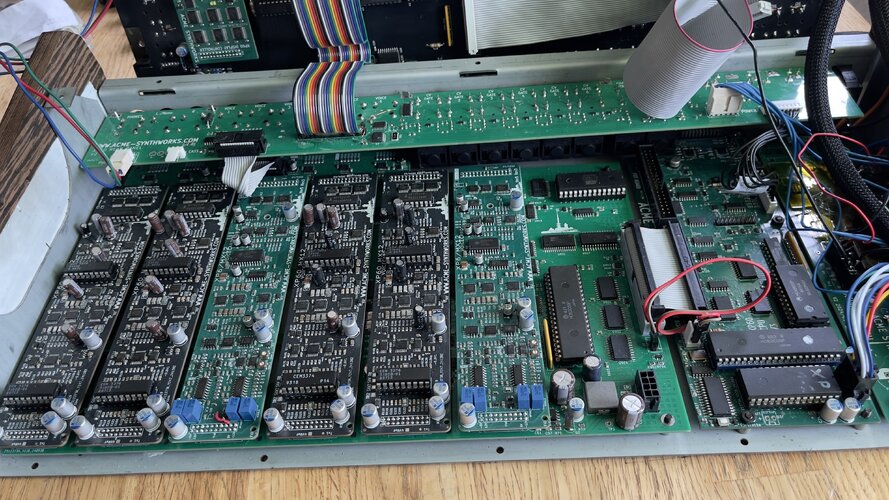
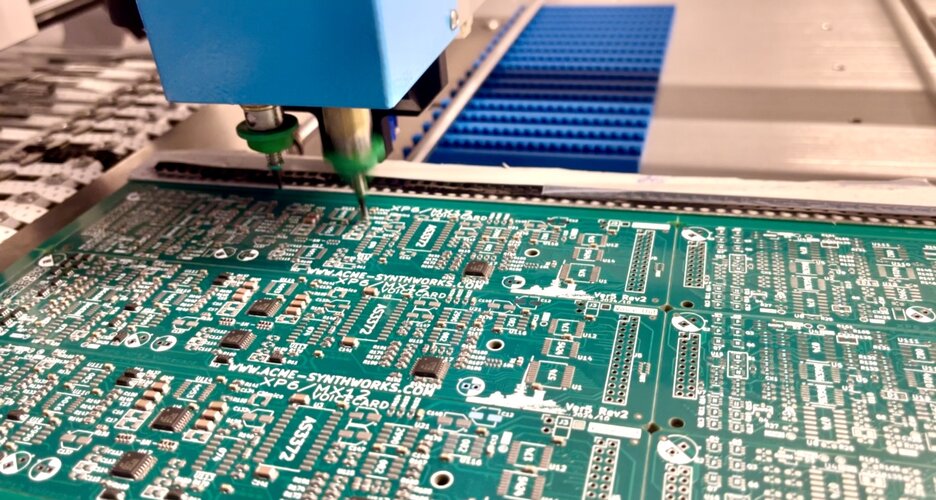
That pushed me to search for viable modern alternatives, which eventually allowed me to redesign the instrument using surface-mount technology and reduce it to a more compact 19-inch format, while preserving the original architecture and behaviour.
I'm interested to hear about the path that led you from fixing synths to building one from scratch?
It's actually a common assumption that I moved from repairing synthesizers to designing one, but in my case it was the other way around.
The development work came first. By designing and rebuilding complete instruments from the ground up, I was forced to understand not just individual circuits, but entire systems - how oscillators, filters, envelopes, digital control, and calibration interact as a whole. That level of understanding fundamentally changes how you approach an instrument.
Alongside the larger projects like the Jupiter 8 and later the Xpander, I was also constantly developing smaller circuits and functional blocks - oscillators, modulation sources, various filters, control circuits, - sometimes as experiments, sometimes as building blocks for future ideas. Some of these could eventually find their way into Modular Systems, although not necessarily in a conventional Eurorack format, which I personally find a bit too small and fiddly for my taste.
Only later did this development experience start to flow back into repair and maintenance work. When you've designed replacement circuits, validated component behaviour, and dealt with long-term stability issues yourself, diagnosing faults in vintage instruments becomes much more systematic. You're no longer just replacing parts; you understand why something fails, what tolerances matter, and which deviations are acceptable without altering the character of the instrument.
In that sense, the XP60 is not the result of years of repair work leading toward design, but the opposite: it's a design-driven project, informed by practical experience with real instruments in real-world conditions.

Why the Xpander, do you have a personal history with this machine?
The Xpander has a very personal significance for me, but also a very rational one.
The first time I encountered an Xpander in real life was in the late 1980s, in a private studio. At that time, it felt almost unreal - not just because of the sound, but because of the depth of the architecture. It wasn't a synthesizer you simply played; it was a system you explored. That experience stayed with me for a long time.
From a technical perspective, the Xpander represents a very different design philosophy compared to instruments like the Jupiter 8. Where the 8 is immediate and performance- oriented, the Xpander is modular in spirit. Its strength lies in the modulation architecture, the filter variety, and the way complex interactions can be built systematically rather than intuitively.
After working extensively on the Jupiter 8 architecture, the Xpander felt like the natural counterpoint. Sonically and conceptually, it occupies the opposite end of the spectrum. That contrast was exactly what made it interesting to recreate.
Despite its age, the design still feels remarkably modern. The XP60 exists because the Xpander is not just a classic synthesizer, but a fundamentally well-thought-out system whose architecture still deserves to exist in hardware today.
I assume that in 2026 - with reissued CEM VCO/VCA chips available, it's fairly practical to re-create these designs - did you experience any major issues/roadblocks along the way?
Modern reissues and equivalents certainly make projects like this more realistic, but they don't remove the core challenges. In the case of the Xpander, the filter and VCA section is a good example. The original CEM3372 is no longer available, but the AS3372 reissue is a solid and well-behaved replacement, and it's what I use in the XP60. That part of the design is relatively well covered today.
The dual VCO IC is a different matter. If a true reissue of that chip becomes available in the future, that would obviously be very welcome - but I tend to believe such things only once I can actually buy the part and build with it;-) Designing the XP60 around scarce and extremely expensive original dual VCO chips was never a sustainable option.
There are also more subtle aspects to reissues that are easy to underestimate. Over its lifetime, the original CEM3372 went through several revisions, and they don't all behave identically. One of the most noticeable differences is the resonance response, which varies between revisions.
With modern reissues, it's not always entirely clear which original revision served as the reference. However, the chip alone never defines the sound anyway. A significant part of the resonance character and overall behaviour is shaped by the surrounding circuitry.
For the XP60, I used the later Rev. D behaviour of the CEM3372 as a sonic reference, as it exhibits a smoother and more controlled resonance response. The external circuit was adjusted accordingly to match that character as closely as possible.
More generally, even with reissued ICs available, recreating these designs is not a matter of dropping parts into an old schematic. The real work lies in understanding how the original circuits behave as a system - timing, modulation depth, calibration routines, thermal behavior, and all the small interactions that only reveal themselves in real instruments. Matching that overall musical response is far more challenging than sourcing individual components.
Wow, very intricate work! Looking at the XP60 next to an original Xpander, it's remarkable how closely you've managed to evoke the spirit of the original in your new design - even the buttons! Are these still made, or did you find a pile of new old stock switches?
The guiding principle throughout the design was to find a compromise that preserves the spirit of the original Xpander as faithfully as possible, while adapting it sensibly to today's technical and practical realities.
Visually and conceptually, the overall layout remains very close to the original. The three- display concept was deliberately retained, as it's a core part of how the Xpander communicates information. Internally, the original CPUs are used, so the instrument behaves exactly as the original does at a fundamental level.
The enclosure itself was made more compact. When the Xpander was originally designed, studio environments were very different - there were fewer instruments, fewer racks, and simply more physical space available. Today's studios tend to be much denser, so reducing the footprint felt like a reasonable and practical adjustment, without compromising ergonomics or usability.
The buttons are a good example of how this compromise works in practice. They are arranged slightly more compactly, but the goal was always to preserve the feel and interaction rather than the exact dimensions. There is no stock of NOS switches involved. Instead, modern switches are used, and the button caps themselves were carefully modelled to closely match the original Marquardt caps. These caps are produced using 3D printing, allowing fine control over shape and feel.
Even smaller details were treated with the same mindset. The flow chart printed on the original Xpander's front panel was also recreated. While it's necessarily smaller and only easily readable up close, it felt important to include it - not because it's strictly necessary, but because it's part of how the original instrument presents itself and how users relate to it.
Overall, the intention was never to miniaturise or modernise the Xpander for its own sake, but to respect its original design language while making thoughtful, technically sound adjustments where they genuinely improve practicality and longevity.
Yes, I notice some modern tweaks; the illuminated rings around the knobs are a nice touch - plus the displays have changed, I assume that this is due to the headaches associated with VFD displays?
The original Xpander uses VFD displays, and for good reason. They look beautiful, have a certain calm presence, and are very much part of the instrument's identity. From a visual standpoint, they're hard to beat.
The problem is that the original controller-less starburst VFD displays are no longer available, and the well-known downsides of VFD technology haven't gone away either - availability, ageing, high operating voltages, power consumption, and heat. Because of that, the primary design decision for the XP60 was to move toward modern OLED displays, mainly for long-term reliability, serviceability, and consistency.
That said, for purists and true nostalgics, there is also a version using modern VFDs. It was important to keep that option open, even if it comes with certain practical trade-offs.
The illuminated encoder rings are a small but useful addition. They support quick visual orientation and make parameter states easier to grasp at a glance. To drive modern displays, an additional controller was required anyway, and it made sense to integrate the RGB ring control there as well.
Because the VFD version already has a higher power demand, it does not include the LED rings. Adding six rings with seventeen RGB-LEDs each would increase power consumption and heat significantly, and in a more compact enclosure that simply wouldn't be sensible.
Despite the different display technologies, the information structure itself remains unchanged. Even though the buttons are no longer physically embedded into the flow chart, the overall layout and interaction remain logically consistent with the original Xpander, so the mental model and workflow are preserved.
As a small practical addition, the XP60 also includes a dedicated headphone amplifier with four selectable gain levels, allowing it to be matched properly to different headphone impedances. This is one of those areas where a subtle modern improvement makes everyday use more comfortable without altering the character of the instrument.
Great idea for headphone users. So it's slightly smaller than the Oberheim, then?
It is significantly more compact than the original Xpander. This was a deliberate design decision, not a side effect. While the XP60 is not intended as a rack-mount instrument, its width was consciously aligned with the 19-inch format as a familiar and practical reference.
The Xpander implemented modulation sources in software (LFO's, envelopes, etc) - a fairly common practice around this time (my Prophet 600 has them too) - how have these been emulated? Does it run the original 68B09 code via emulation, FPGA, or perhaps original NOS chips?
The Xpander already relied heavily on software for modulation sources like envelopes, LFOs, and the modulation matrix, and preserving that behaviour was absolutely central to the XP60 project.
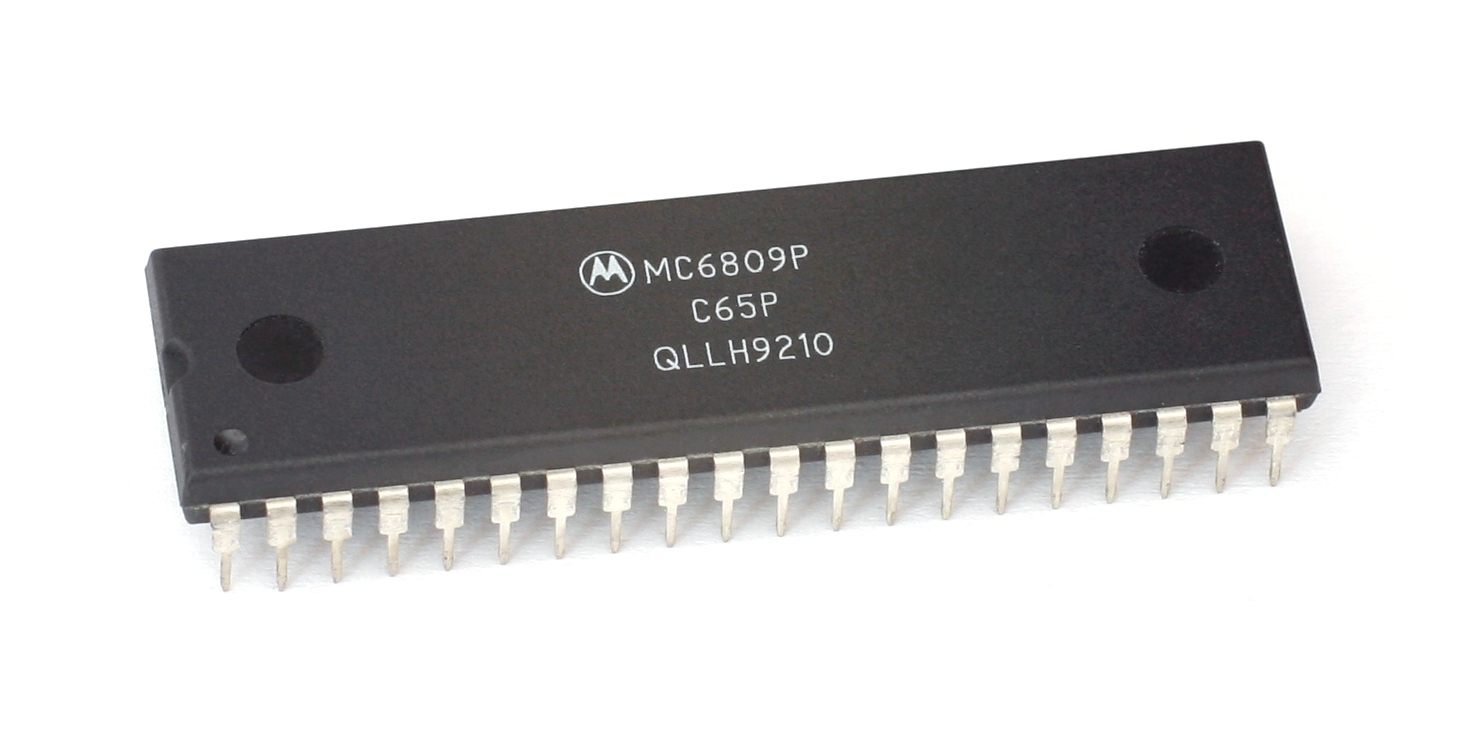
The original dual-CPU architecture is retained. One CPU handles voice allocation, MIDI, user interface, and patch management, while the second CPU is dedicated entirely to envelopes, LFOs, and the modulation matrix etc. These are original NOS CPUs running the original firmware - there is no reimplementation, no emulation layer, and no FPGA involved.
 Roughly ninety-five percent of the design effort was focused purely on preserving the original character and behaviour as faithfully as possible. The remaining few percent are very small, carefully chosen refinements that aim to make the instrument more practical and expressive in a modern context, without altering its identity.
One example is an optional "Turbo Mode", where the voiceboard CPU can run at a 50% higher clock rate. This mode is user-selectable and can be enabled or disabled by the user. When enabled, envelopes and LFOs scale proportionally, preserving their original relationships and behaviour rather than introducing new features or resolutions. With Turbo Mode disabled, the instrument behaves exactly like an original Xpander.
There is also a subtle adjustment in the analogue control voltage domain. The envelope generation itself remains unchanged and follows the original timing, but the CV shaping path was optimised so that very fast envelope transitions are translated more musically. On the original instrument, extremely short envelope times can effectively collapse into abrupt level changes. The refinement in the XP60 allows these fast transitions to retain a more natural exponential contour, without altering the programmed envelope times themselves. As a result, the original behaviour is preserved, but its expressive potential at very short settings comes through more clearly.
Overall, the XP60 is not about adding more, reinterpreting the architecture, or modernising the instrument for its own sake. It is about preserving what made the Xpander special, while applying a very small number of carefully considered refinements that allow it to function comfortably and reliably in the 21st century.
Vintage Xpanders are sought-after classics - the price rising every year! Have you got a price in mind for the XP60?
Vintage Xpanders have certainly reached prices that place them firmly in the collector market. That wasn't the motivation behind the XP60. While I'm not ready to announce a concrete price yet, the intention is very clear: the XP60 is meant to be positioned significantly below the current prices of well-preserved original Xpanders. The goal is not to compete with collectors, but to make this type of instrument realistically accessible to musicians who actually want to use it.
At the same time, it's a small-scale project with a high level of craftsmanship and a great deal of manual work involved, so it won't be a budget product either. The final price will reflect that balance - respectful of the original instrument, fair in today's market, and honest about what it takes to build something like this properly.
That's Fair. So have you got a favourite sound design trick on the XP60? Using FM perhaps, or one of the filter types?
I don't really have a single favourite sound - it very much depends on mood and context.
That said, I often find myself drawn to very direct, hard-edged bass sounds. A typical starting point for that would be both VCOs running SAW, with PWM added for movement. VCO2 is often set to TRI as well and slightly detuned downward to add weight and instability. The PWM is usually modulated slowly by an LFO to keep the sound alive without making it obvious.
On the filter side, I tend to use the 3-pole low-pass with just a touch of resonance - enough to give it character, but not enough to thin it out. The result is a very solid, punchy bass that works beautifully for more aggressive, EBM-style lines, but still has the flexibility to be shaped further through modulation.
That's one of the things I enjoy most about the Xpander architecture: even relatively simple patches can feel deep and expressive, depending on how you approach them.
How can our readers get in touch and register their interest?
The easiest way is through the interest list on my website. There's a simple form where people can register their interest without any obligation and choose basic configuration preferences.
https://www.acme-synthworks.com
I use this list mainly to get a realistic picture of demand and to keep interested users informed as the project progresses. Once the XP60 is ready for production and all details are finalised, people on the list will be contacted directly.
Thanks for such an interesting, in-depth interview Markus. The journey here couldn't have been easy and you deserve our admiration and respect. Best of luck with the release!

Get the latest headlines, offers and more in our fly sonicstate newsletter - delivered to your in box every week

- Kemistry & Storm Interview 23-Sep-26
- Top 10 Video Game Soundtracks 23-Sep-26
- Simon The Magpie's Fluxophone 22-Sep-26
- Free Akai Sampler & MPC Firmware Mods 22-Sep-26
- Terrifying Sounds From Schoolkids 22-Sep-26
Even more news...
Get Our Newsletter
More...
 Erica Synths Razornator - Sonic Demo
5 stereo Chromatic resonators in a desktop effect
 3D Design Print Your Own Synth Stands With Loopop
Web app for your custom stands
 SinTH2 60 Voice Monster Polysynth
All digital hardware beast
 Sonic RETROCAST 4 - Robert Henke AKA Monolake
Retro computing live and other topics
 The Bristol Old City Studio - Drop In Tour
We take a tour and find a Polymoog too
 SonicLAB: Behringer FLOW4V 32-Bit Float Recorder
And FLOW4VIO


