WaveBoy: A 12-bit Wavetable & PCM Oscillator
US We Speak to Designer Tim Soderstrom 26/08/25

|
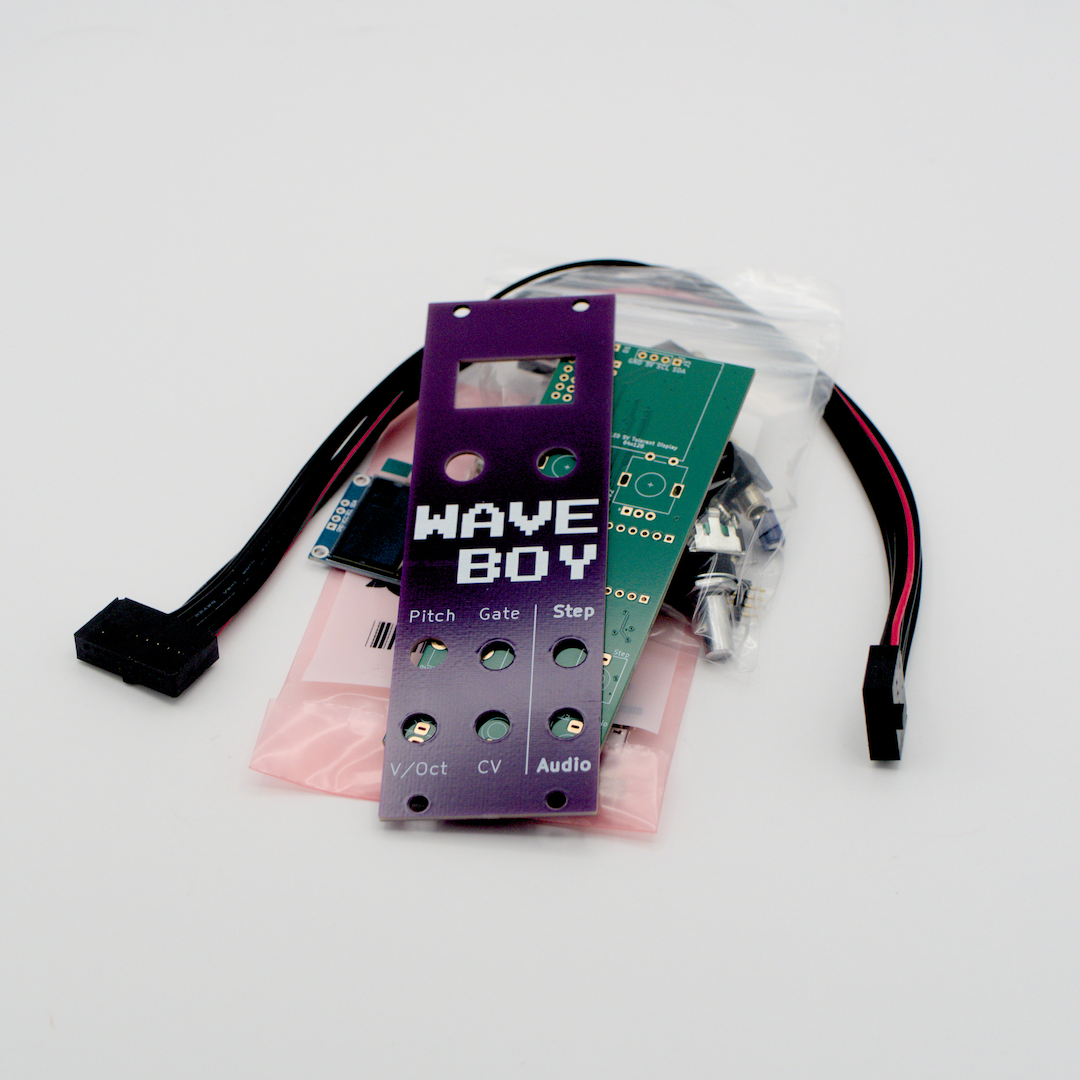
WaveBoy from Bit by Bit synths is a delightfully purple 8HP module. It implements the behavior of the Nintendo GameBoy's 4-bit wave channel: This plays back lofi wavetables of 32 samples long. If you've heard LSDJ then you'll know the sound!
One standout feature is the variable clocked DAC at WaveBoy's core. This means that the sample rate of the DAC is directly linked to the notes you play, no interpolation, no anti-aliasing!
Other features include:
- A Noise mode that has LFSR and a number of bitwise noise algorithms
- A 12-bit Sampler that supports basic loops and bitcrushing
- The 2nd output that can be used for step sequencing, as an alternate audio output (for detuned or sub-out), or as an LFO
- A realtime bit/sample crusher and envelope follower are also available.
We sat down with designer Tim Soderstrom to discuss his bundle of 12-bit grunge:
Paulee: Thanks for talking to us Tim - so I'm really excited to hear all about your Wave Boy 12-bit oscillator, but I thought we'd back up a moment and talk about your beginnings. From your Etsy shop, I deduced that you have passions in modular synths and analog photography - have you always been a tinkerer?
Tim: I haven't thought about it that way, but yes I suppose I have! I got in trouble as a kid for opening up one of my electronic toys :) And started building my own PCs before that exploded into what it is now. I am one of those obnoxious people that insist on watercooling their PC so yeah I guess that checks out! The photography side of things came to be before the synth stuff. They share the same ethos and purpose. To help their respective communities grow and make it easier to get into the hobbies.

Paulee: Your laser-cut wood/acrylic eurorack cases, with rear 4HP slot (for UZeus, etc), seem a great small modular solution - what inspired you to design them?
Tim: Great question! I had desired modular for years before finally deciding to jump into it. One of the reasons it took so long was the cost and lack of variety of cases. That felt like a huge first barrier, especially when you had to plan well for the size modular you wanted when you might be too new to know even what you might need. It didn't feel very iterative. And when I did get into modular, sure enough, I ran into those issues. To me modular is an exploration and rigid case designs just didn't feel like it was catering to that as much as I wanted.
So I wanted to try and lower the barrier of entry and have something that could let folks naturally grow into modular. My original idea design centered around "modular cases for modular synthesizers" and that's what the X-series cases are (X stands for eXpandable). My own case is made up of several X-cases attached together for instance, so I'm living my own ethos. I also added the Skiffy's which aren't as expandable but are smaller and still have a mind on cost in as best as I can do so given our volume ( still laser cut these in my garage for instance). The Skiffy's have proven to be quite a bit more popular but I still offer both (and am working to expand to more case options for both). And I think that's the other fun inspiration with modular. It invites big and small players into this space where we can all have fun. Since I've come out with my cases, there are now a lot more case options available too, which is great to see!
Paulee: It is great to see. So onto your new module, Wave Boy - is this your first module design?
Tim: My first fully released one, yes it is! It's not my first circuit design but is my first which is predominantly surface mount with a 4-layer PCB. I've designed various things across the photography and synths stuff, but most of these were for my own or my band's needs. I'm very happy of how it turned out! In transparency too, I stand on shoulders of folks like Mutable Instruments and Ornament & Crime. The impact Mutable Instruments has had in particular on modular cannot be over-stated and I learned a lot from looking at their open source designs to gain a better understanding of some of the more typical common circuits you tend to find with modular. Likewise, I did get some help with some of the more intricate parts of the PCB design.
Paulee: Nintendo's Game Boy seems an obvious inspiration, but did any other designs inspire you in terms of functionality?
Tim: It was the original inspiration yes. I make chiptune on many things, but it's mostly the GameBoy, especially with my band (some of our music is a hybrid chiptune / surf sound we simply call "chipsurf"). The main feature of the WaveBoy approximates the wave output of the GameBoy (as realized through the LSDJ tracker) in as close as I could get it. This includes using a variable clocked DAC rather than a modern audio DAC/codec that has a fixed sample rate. That's what gives the GameBoy a lot of that unique character coupled with the coarse wave-forms. It's a gorgeous sound and my main goal was to try to implement this in Eurorack land.
While learning about variable clocked DACs I learned that other things, like the Commodore Amiga, some early Akai MPCs, and the LinnDrum all may have had similar designs. The LinnDrum inspired the Sampler mode, sort of. So you could say I'm also paying homage to early digital audio as a whole.
Paulee: Out of interest, what's your history with computer music/chiptunes?
Tim: I grew up as a 90's tracker kid. Being in the US and growing up in a small town, I didn't have much access to the full Demoscene, but I was definitely on #trax on IRC back in the day (and will still pop in on a #trax somewhere every so often). My tool of choice was Impulse Tracker. In college I jammed out with a good friend of mine (then having moved to Renoise mostly). He went on to complete his PhD and some years later just happened to have landed a job at the University where I live. So we got back to jamming and eventually formed our band, Victim Cache (named after a CPU cache because we're total nerds).
We tend to alienate our audience, multiple times :) because we keep exploring new sounds. But our first sound, and one we always come back to, is the chipsurf stuff. So a GameBoy (or if I'm traveling an Analogue Pocket) is often in my hand making some jams. Occasionally I'll still bust out the NES and MB6582 SID synth too!
We do non-chiptune stuff also, and recently have even been exploring DAWless. Despite WaveBoy being very digital (by design), I quite also enjoy analog stuff. So our DAWless journey is largely being done with a Tascam Portastudio along with some reel machines with tape loops and things. Often with the WaveBoy doing something in tandem with something else. The combination of that aliased sound of WaveBoy (for me often run through a Doepfer WASP filter), thrown onto tape is a stellar combination!
Paulee: Heh, I run my Amiga into a WASP filter all the time! And I love the sound of variable sample rate playback (with aliasing!) What motivated you to bring this sound to a modular audience?
Tim: Our workflow for our current and last albums in the band probably planted the seed. I adore making music on the GameBoy, and for our chipsurf stuff, the workflow is basically perfect. There, we have a few narrow "limitation breeds creativity" mindset. It's most often a GameBoy and raging surf guitar. But for our other stuff, we have a lot more going on. That meant trying to come up with something on the GameBoy would sometimes stop our flow. I think that can be a good thing, but not always.
One day I was looking at Osiris in my rack – a modern wavetable module and quite an interesting one in its own right – and started thinking about the fact that the WAVE channel in LSDJ is similar to a super slimmed down wavetable. I didn't think there was anything quite like what I was thinking already and looked up what was known about the GameBoy's audio architecture. It didn't take long to realize how I could build that and off I went! I had to decide early on how sort of "pure" to be. I had an idea of using an FPGA for the variable clocked DAC portion (and I still ponder that sometimes). But given cost, I landed on the Adafruit ItsyBitsy M4 platform. The mechanism is still quite close to the GameBoy – there's a hardware timer that fires off to update the DAC – the period of that timer, in wave mode, is 32 multiplied by the current pitch. 32 because there are 32 samples in each of the 4-bit waveforms.
This is what I find so elegant about the variable clocked DAC. At it's core it is a very simple idea which avoids some deeper concepts and that makes building one equally simple. The input side of WaveBoy is pretty standard to Eurorack (a V/Oct, a Gate and a CV), though as a sidenote, I had to learn a lot about how SAR ADCs work and one challenge was how to improve the pitch tracking. That was actually perhaps the most challenging part to the whole thing and the main place I needed to get some help in understanding.

Back to the DAC, I guess in Eurorack terms, you can kind of think of what I am doing as a sort of sample and hold circuit. The controller outputs a value to the DAC which translates to a voltage and that voltage is held until the main audio timer triggers, when another value is fed into it. I'm just doing this at audio rates.
This is what made things like the LinnDrum so iconic because the lower the pitch, the lower the sampling rate without any interpolation going on that tends to happen when using a fixed output rate. They are correlated in this very direct way and you get this sound that's hard to emulate.
That was a big windup to say, building a variable clock DAC can be done in many many ways. In fact early on I thought about making a discrete DAC (using a resistor-ladder design) and may still do that in a future WaveBoy model just to see what that sounds like. So building this with modern components was easy. I just had to balance features, sound and cost.
Paulee: You've certainly packed a lot of tech into this module! Wavetables, different noise-types, and sample playback (with looping) - how do you, as a designer, balance immediacy, number of functions and the needs of your users (with different sized systems)?
Tim: This is a phenomenally good question. It's hard :) My small photo and synths business are much too small right now for me to do full time (hopefully one day!) but in my day job, that comes up a lot. In my field folks like to throw shade on project managers – and that's sometimes for good reason. But the converse is an important lesson I learned. Engineers (including me) like to engineer. It's what we do. And that means we can OVER engineer.
There's a balance there and I won't claim I have solved it. The WaveBoy UI has some rough spots, I will admit, in the current form as an example. Part of this is iterating through design (something I also am a fan of, maybe to a fault having a sort of "Rome wasn't built in a day" mentality) and there's some feature creep.
Some of the newer features were for my band-mate, who is building a guitar-centric modular effects rig. I felt bad that I gave him the Eurorack addiction so opted to put in some features in to WaveBoy so he had some utility in his rack. The LFO, Realtime Bitcrusher (which is very fun by the way!) and Envelope Follower were all things I arguably made for him.
To get back to the question though, I'm trying to balance adding as much value as I can to WaveBoy without making it a nightmare to use. I'm getting there! But it is a journey! The value is really important to me though. It's extremely important to me that folks get something they like and enjoy that betters the community. That's nearly paramount for me.
If someone is wanting to spend their hard earned money to buy my module, I owe it to them to make it as useful as I possibly can. That's true especially given I want folks to have an easier path to get into modular, and one way to do that is modules that have lots of utility. That's all while trying to keep the main purpose of the module though.
Paulee: Do you have any favourite modules that pair well with the Wave Boy?
Tim: My favorite Waveboy patch tends to be:
WaveBoy -> Deopfer WASP -> Expert Sleepers' Persephone -> AI Synthesis' tape delay (with an UHER reel to reel deck) -> Typhoon (Mutable Clouds clone - usually for its glorious reverb).
I don't do that all the time, but it's usually where I start. It all just works sooo well with the quirky WaveBoy sound and I can dial that up to and past 11 if I want or bring it down to something realistic. It works in basically all the audio modes too, be it wave, noise, or the sampler. More often than not I'm using the volume envelope on the WaveBoy as it adds even more of that GameBoy sort of sound and will often then use the Step output in wave mode as part of the modulation of the filter (at least if I'm doing some sequencer/arpeggio sorta thing).
Paulee: Gotta love those 8-bit arpeggios! What do you think the Wave Boy's standout features are?
Tim: I love them all! But it has to be the feature which started the whole journey and that's the Wave mode. I really like the Noise mode too since I had a ton of fun just messing around with coming up with crazy noise algorithms in addition to the normal ones. The Sampler is great when you want that early sampler sound. But I really do use all the features of WaveBoy in something so really beyond the main Wave feature, it's hard to pick a favorite.
Paulee: How can our readers purchase a module?
Tim: Today you can go to bitbybitsynths.com to pick one up from us directly. Since we're a small store and VAT stuff can get complicated, we do recognize that this can be annoying and do plan on putting the WaveBoy up on Etsy (where we also sell our modular cases) and/or Reverb. We tend to make these "to order" which is the other reason we haven't yet expanded to Etsy and other places yet. But we're working on it.
Paulee: I see there's a DIY kit version, was this important for you to offer?
Tim: Yes definitely! That was the plan for the onset, although I had to pivot somewhat for cost/size reasons. A lot of the module is made up of surface-mount (SMD) parts. I avoided that early on and do still have a lighter feature version of the WaveBoy that can be built with all through-hole parts. It costs more and does less though.
So instead, I switched to SMD parts. This let me keep the WaveBoy the same size while adding more I/O and, on the DIY side, dramatically lowers the part count. That makes it easier for me to pack the DIY version and easier for folks to assemble it. This was one way I could lower the cost with some trade-offs to consider.
Paulee: Finally, any plans for the future? Distribution? More module designs?
Tim: Yes indeed! I have other module ideas in my head, and also looking at some of the past non-Eurorack designs I made which could be useful to others. I also dabble in retro and was playing with some hardware ideas for the Commander X16 retro computer while I was writing a tracker for it, some of which would also have a leg in modular land.
For now though, I think it's important for me to focus on the WaveBoy itself first. I don't consider the Wave feature fully implemented yet. It's very usable now but I can make it better. Basically I'd like to get close to a 1.0 firmware release of WaveBoy and work on learning how to make our own distribution more efficient first. Our documentation is also a little too bare bones.
Oh my, would distribution be incredible! If we ever get to that point, I feel like we would have "made it" and would have grown up from tiny mom and pop synthesizer company running out of our house to known brand. And would probably be good for everyone. Noting I wanted to lower the barrier to entry to modular. I'd like to get the cost of WaveBoy down and one way to do that is volume. That might be putting a lot of faith in folks wanting a quirky niche module from a small company like ours; or our ability to scale - but it would be amazing and something I do dream about. Goals are important after all! Not necessarily to reach them, but to make you embark on the journey.
One thing that's nailed some other Eurorack companies too is getting too big (at least too big too fast) and trying to balance that I think is no easy feat. So at the end of the day, I'm just happy to be doing what we're doing and trying to play our tiny role in making the world, at least in terms of music, a better place.
I will say, noting earlier that we stand on the shoulders of giants, the firmware is open source and I do plan on figuring out something for the hardware. I do worry a bit about self competition. The WaveBoy is my baby and I'm proud of it, but the hardware isn't really all that unique. And I knew day one I had to pay forward all the incredible efforts made by those that came before me, again noting Mutable Instruments, who opened up their designs. I say all that because that is also a route for a more economical WaveBoys and one I am exploring too.
This wasn't a question but by the way, thank you so much for taking the time to talk to me! It means the world to me someone found what I've built worthy of paying any attention to. Honestly welling up with some tears of joy in writing this. I feel very honored and greatly appreciate it and the work you do at large! (I'm not crying, you're crying! - Paulee)
I hope people enjoy the module! Even for those that don't buy it, I hope this gets folks more into chiptune, or Eurorack or something musical. The world is, well, the world right now and I'd like to think most of what drives me is trying to make it a better place. WaveBoy isn't going to end world hunger. But if it helps contribute to the journey of music for other folks, well, that's still something!
Get the latest headlines, offers and more in our awesome sonicstate newsletter - delivered to your in box every week

Get Our Newsletter
More...
 Erica Synths Razornator - Sonic Demo
5 stereo Chromatic resonators in a desktop effect
 3D Design Print Your Own Synth Stands With Loopop
Web app for your custom stands
 SinTH2 60 Voice Monster Polysynth
All digital hardware beast
 Sonic RETROCAST 4 - Robert Henke AKA Monolake
Retro computing live and other topics
 The Bristol Old City Studio - Drop In Tour
We take a tour and find a Polymoog too
 SonicLAB: Behringer FLOW4V 32-Bit Float Recorder
And FLOW4VIO


