Exploring Yamaha's FM Synthesis Chips
US Ten-part series covers the YM3812 21/01/25Yamaha's FM Synthesis chips were ubiquitous for many years, in synths, keyboards, and PC soundcards so it's fair to say have been pretty influential to the sonic landscape we've become familiar with. This incredible series from Things Made Simple takes a look at the chips, with a proverbial deep dive on the YM3812, in ten stages...
YM3812 Part 1 – Register Basics
YM3812 Part 2 – FACE Reveal
YM3812 Part 3 – Behind the Code
YM3812 Part 4 – MIDI Journey
YM3812 Part 5 – MIDI Polyphony
YM3812 Part 6 – Patches
YM3812 Part 7 – Percussive Maintenance
YM3812 Part 8 – Velocity Sensitivity
YM3812 Part 9 – Synth Card
YM3812 Part 10 – Pitch Bend
Here's an excerpt from Part One:
Introduction
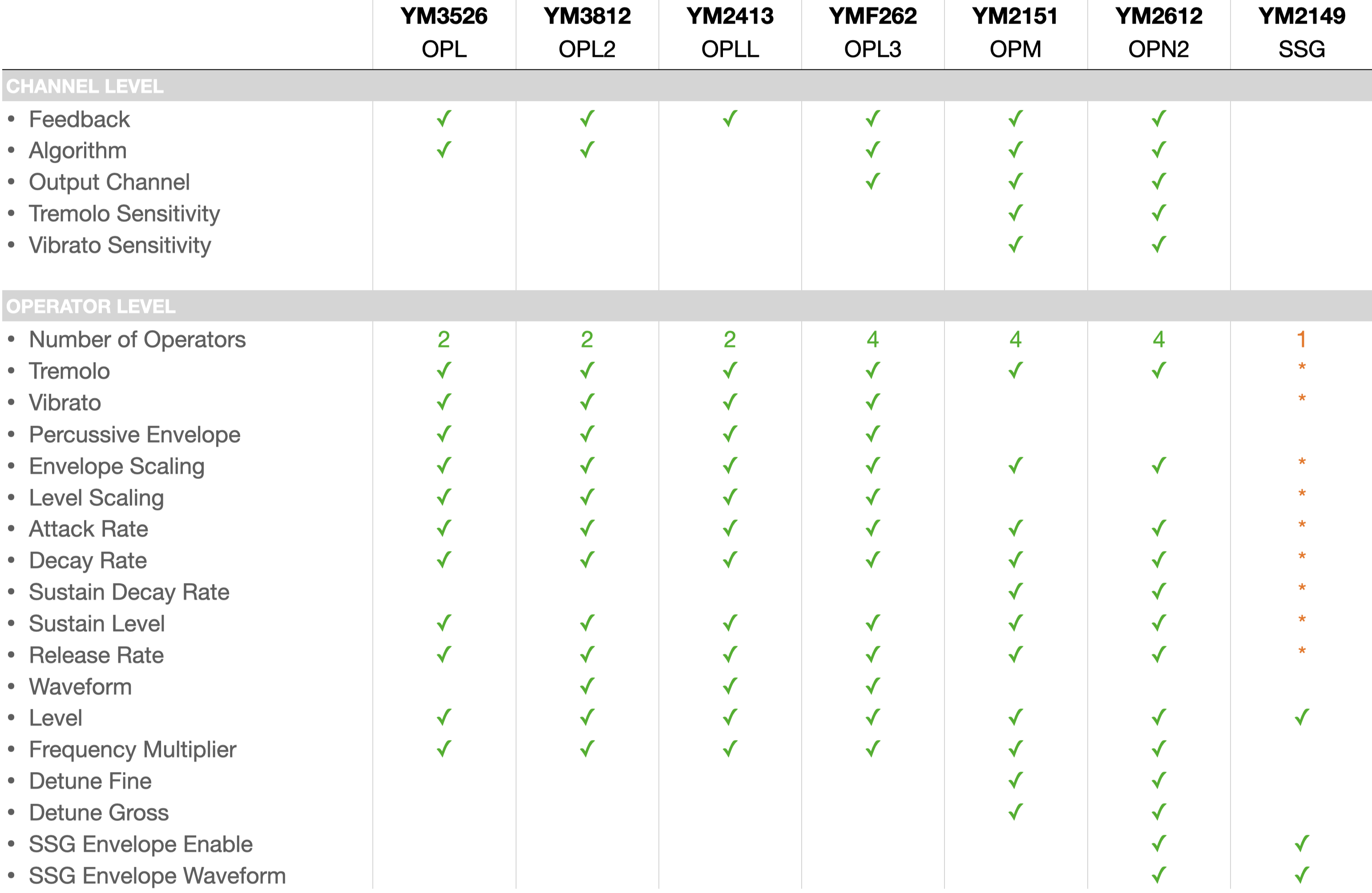
In conducting a pretty extensive deep dive into Yamaha's FM synthesis chips, I've come to realize that while these chips produce very unique sounds, they are also largely very similar. In fact, if you compare their register settings (and ignore the level of granular control that you get), you can see just how many of the settings are the same:
Comparison of Yamaha FM Synthesis ChipsWith all of these similarities in mind, I originally planned to build a single module with a variety of sound processor types all controlled by a single microcontroller. After breadboarding this idea out with a YM3812, YM2151 and even a non-Yamaha SN76494, it worked! And I was even able to translate chip settings from one chip to another seamlessly. But when I started to document how it worked, I realized from a complexity standpoint, I needed to back waaaay up and start from the beginning. To get into the advanced stuff, we need to start with a smaller project that lays a strong foundation. And what better foundation than a Eurorack module powered by Yamaha's YM3812 OPL2 sound chip. A chip that revolutionized computer audio for the video games of my childhood.
This article is only the first in a series. Together, we will tour the properties of the YM3812, design the hardware for a module and write the supporting microcontroller code. Hopefully, each article will pair with a YouTube video on the subject as well.
Read part one here: https://www.thingsmadesimple.com/2022/11/28/ym3812-part-1-register-basics/
About the author [midierror]: midierror is co-founder of Potato Audio, he makes nifty Max For Live devices, award-winning Sample Packs and hosts the 'midierror meets...' interview series speaking with all kinds of people working in sound & music.
Get the latest headlines, offers and more in our slick sonicstate newsletter - delivered to your in box every week

- Ambient Soundscapes for BBC Proms 05-Oct-26
- A/V Experiment: A Free Visual Music App 05-Oct-26
- A Storm Coming to our Plugin Market? 04-Oct-26
- Free Convolution App from Loopop 02-Oct-26
- Erasure's 40 Years of Friendship 02-Oct-26
Even more news...
Get Our Newsletter
More...
 SonicLAB: Behringer FLOW4V 32-Bit Float Recorder
And FLOW4VIO
 SonicLAB: Korg Nu:Tekt NTS-4 Performance Mixer
With FX and 2 Ch USB audio
 SonicLAB: Genki Katla With Venus Theory
We look at the volcanic synth
 Lifeforms SV-2 - Pittsburgh Modular's Redesigned Semi-Modular
SV-1 successor with thru-zero FM
 SonicLAB: Pittsburgh Modular Lifeforms SV-2
Classy analogue synth reviewed
 AmiGUS mini: 24-bit Sound for Amiga 1200 & 600
32 Channel PCMCIA Soundcard in Beta


