Fascinating Prototypes that Never Made it to Market - Part Two
US Synths Pulled Before Their Commercial Debut 14/01/25
|
Not every instrument makes it's way into the hands of the synth buying public. Reasons for this vary; some companies fold, others remain healthy - but simply decide to focus on different products. Whatever the reason, these prototypes exist only in small numbers:
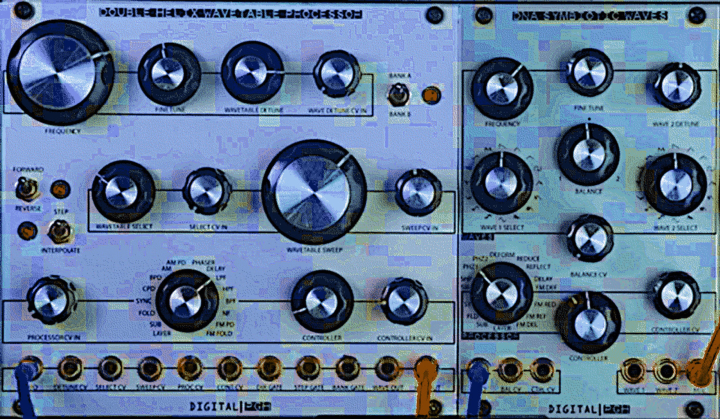
Pittsburgh Modular - Double Helix Wavetable Processor
Pittsburgh Modular are an innovative Eurorack company that aim to "push analogue forward" in a number of ways. One example - the unique modulatable "blade wave" that adorns many of their analogue oscillator designs
In 2014, Pittsburgh released it's first (and only) commercial digital dual oscillator, called DNA Symbiotic Waves. It comprised of two sets of 8-bit digital waveforms (think Prophet VS style) and some interesting methods for combining these two waves:
- Deform
- Reduce
- Reflect
- Delay
- FM Deform
- FM Reduce
- FM Reflect
- FM Delay
- Layer
- Subtract
- Fold
- Sync
- Switch
- Shift
- Phaser 1
- Phaser 2
By adding a decent analog filter (as my first ever Eurorack module, I ran mine through an Arturia Minibrute) the module creates interesting hybrid tones; some in an Ensoniq ESQ-1 vein, some like you've never heard before! In the above video, founder Richard Nicol shows off some DNA tones first - before moving onto something far rarer, the Double Helix Wavetable Processor.

Unlike the DNA, this one was never released commercially. Specs for the mythical beast included 16 wavetables, wavetable detune, stepped or interpolated scanning, plenty of CV connectivity & a number of unique processor modes, different to those featured on the Symbiotic Waves:
- PD1 L
Reads the wavetable non-linearly and at a much lower pitch. 'Controller' adjusts the amount of 'non-linearity', enabling sweeps between the original sound and a lower, discordant sound. WT Detune introduces movement into the sound.
- PD1 M
Reads the wavetable non-linearly and at a slightly lower pitch. 'Controller' adjusts the amount of 'non-linearity', enabling sweeps between the original sound and the lower, discordant sound. WT Detune introduces movement into the sound.
- PD1 M
Reads the wavetable non-linearly and at a higher pitch. 'Controller' adjusts the amount of 'non-linearity', enabling sweeps between the original sound and the higher, discordant sound. WT Detune introduces movement into the sound.
- PD2 L
Reads the wavetable non-linearly and at a pitch one octave lower. 'Controller' adjusts the amount of 'non-linearity', enabling sweeps between the original sound and the lower sound. WT Detune introduces movement into the sound.
- PD2 M
Reads the wavetable non-linearly and at the same pitch. 'Controller' adjusts the amount of 'non-linearity', enabling sweeps between the original sound and the non-linear sound. WT Detune introduces movement into the sound.
- PD2 H
Reads the wavetable non-linearly and at a pitch one octave higher. 'Controller' adjusts the amount of 'non-linearity', enabling sweeps between the original sound and the higher sound. WT Detune introduces movement into the sound.
- PD3 L
Reads the wavetable non-linearly and at a pitch two octaves lower. 'Controller' adjusts the amount of 'non-linearity', enabling sweeps between silence and the non linear, lower sound, giving the effect of bit rate reduction. WT Detune introduces movement into the sound.
- PD3 M
Reads the wavetable non-linearly and at a pitch an octave lower. 'Controller' adjusts the amount of 'non-linearity', enabling sweeps between silence and the non linear, lower sound, giving the effect of bit rate reduction. WT Detune introduces movement into the sound.
- PD3 H
Reads the wavetable non-linearly and at the same pitch. 'Controller' adjusts the amount of 'non-linearity', enabling sweeps between silence and the non linear sound, giving the effect of bit rate reduction. WT Detune introduces movement into the sound.
- LAYER L
The output from the oscillators is combined with a clone of itself detuned one octave lower. 'Controller' adjusts the fine tuning of the cloned signal.
- LAYER M
The output from the oscillators is combined with a clone of itself at the same pitch. 'Controller' adjusts the fine tuning of the cloned signal.
- LAYER H
The output from the oscillators is combined with a clone of itself detuned one octave higher. 'Controller' adjusts the fine tuning of the cloned signal.
- Phase 1
A Phaser effect with a fixed depth. 'Controller' adjusts the Phase.
- Phase 2
A very Lo Fi Phaser effect with a fixed depth. 'Controller' adjusts the Phase.
- Delay
A coarse digital delay, with the delay time related to the pitch of the oscillator, and a fixed depth. 'Controller' adjusts the delay time.
- Fold
A wave folder. 'Controller' amplifies the waveform until it clips. The waveform is folded back on itself wherever clipping occurs.
Adorned with controls, including 2 supremely tweakable larger knobs - the 28HP(!) Double Helix very nearly made it to market - but the decision was made to concentrate on Analogue designs instead. With Pittsburgh still going strong today - this decision was undoubtedly the right one, but as a fan of digital synthesis - I'd have loved to have seen where this line went next! Very few of these modules exist, a rare gem indeed.
Still, the work that went into this design wasn't wasted!. Developer Maurice (from Bristol, UK) put much of that work into Studio Electronics' Grainy Clampit module. The Double Helix name was also used for a later (analogue) Pittsburgh oscillator - albeit an interesting one with the aforementioned blade wave, FM & 6-stage wavefolder!

Will Pittsburgh Modular ever try digital again? Richard has suggested that such a move would require collaboration with a DSP expert in the local area. If you are that person, then send him an email I guess! Still, the goal of pushing analogue forward is a noble & exciting one, and we wish for them nothing but success.
https://pittsburghmodular.com/
Posted by MagicalSynthAdventure an expert in synthesis technology from last Century and Amiga enthusiast.
Pittsburgh Modular Social


Get the latest headlines, offers and more in our lit sonicstate newsletter - delivered to your in box every week
More From: PITTSBURGH MODULAR
- Pittsburgh Modular Models Their Own Synth 29-Oct-26
- SonicLAB: Pittsburgh Modular Lifeforms SV-2 12-Aug-26
- Lifeforms SV-2 - Pittsburgh Modular's Redesigned Semi-Modular 11-Aug-26
- New From Pittsburgh - Crow 3 Filter, Double Helix Oscillator 03-Jul-25
- Superbooth 2025: Pittsburgh Modular - Boom Chick + Assembler 08-May-25
Even more news...
Get Our Newsletter
More...
 Funniest Reviews from the SonicState Archives: Roland S-10
Trawling our Legacy Site of Candid Synth Opinions
 September Member Discounts - u-he Bazille and Cherry DS-2
Savings of 30% on these and more
 5 Minutes With Behringer 2-XM Sem Clone
With Chris from Boo Electric
 Funniest Reviews from the SonicState Archives: AKAI pt1.
It's Flat-out Grime Time!
 SonicLAB: Knobula Drum Farm
Eurorack Drum synth and samplers
 IMFMSynth - 8 Operator FM Synth Interview
An Interview with Creator, Kaito Sato


