The 68000 CPU turns 45
US A Chip That Powered a Generation of Instruments 19/09/24

|
In September 1979 the world of computing changed forever, with the release of the Motorola 68000 CPU. The 16/32-bit CISC microprocessor was the first in a family of chips that continued until 1994. The 68k's swan song came with the monolithic 68060; Motorola's last roll of the dice before embarking upon their RISC PowerPC adventure.
The 68000 powered many video game consoles of course; The Sega Mega Drive, Neo Geo & Sharp's X68000 all utilized it's powerful architecture. But what of the 68k's musical legacy?
Musical Computers

The Commodore Amiga, Atari ST, Atari Falcon & Macintosh ALL ran 68k CPU's. Each has a musical legacy worth talking about. Starting with the ST, the machine was blessed with a number of compelling musical features right out of the out of the box. Built-in MIDI ports (at a bargain price) made it the natural choice for music studios, and companies like Steinberg & Digidesign were big supporters of the machine. The later Atari Falcon '030 included onboard DSP, used to great effect in tracker programs.

You can read more about the ST's unique software & hardware here:
https://sonicstate.com/news/2024/01/12/computer-music-chronicles-the-90s/
The Amiga may have lost the MIDI war (even though it performed very well in this area, with the right adapter) - but it most definitely won through it's influence on sampling culture. So many Techno, Jungle & Industrial producers started off sequencing 4 tracks of 28Khz sampled sound on an Amiga. Now, much of the magic came from Paula, the Miggy's soundchip, but the 68000 fed her the bits and bytes that let her do that magic.
If you can believe it, the Amiga's musical legacy is bigger than this. The soft-synth, as we know it today, was born in 1985 on this very machine. For this and other stories, check out my documentary on Amiga sound:
The Apple Macintosh had a few cool tricks of her own. Incidentally, Apple switched to RISC PowerPC processors (with a built-in 68k emulation layer) in 1994, never attempting to build a 68060 Mac. Never mind, In the years preceding the 68k Mac was home to a number of exciting musical products, including the 16-bit, 48Khz Digidesign Sound Accelerator card. The features were amazing for 1989:
- Record with rates from 8Khz-48Khz
- Cut, Copy, Paste, Reverse, Silence & Trim
- Fade in and out
- Normalise
- Phase Invert
- Parametric EQ
- Merge (Crossfading)
- Mix up to four Soundfiles
- Timestretch
- Auto-loop
in 1990, their release Deck, offered 4 tracks of digital playback, mixing and non-destructive effects (EQ, Stereo-ise, Delay, Mod-Delay, Chorus) via the same hardware! Again, we see the involvement of specialist expansions - but the 68k was still running the show.
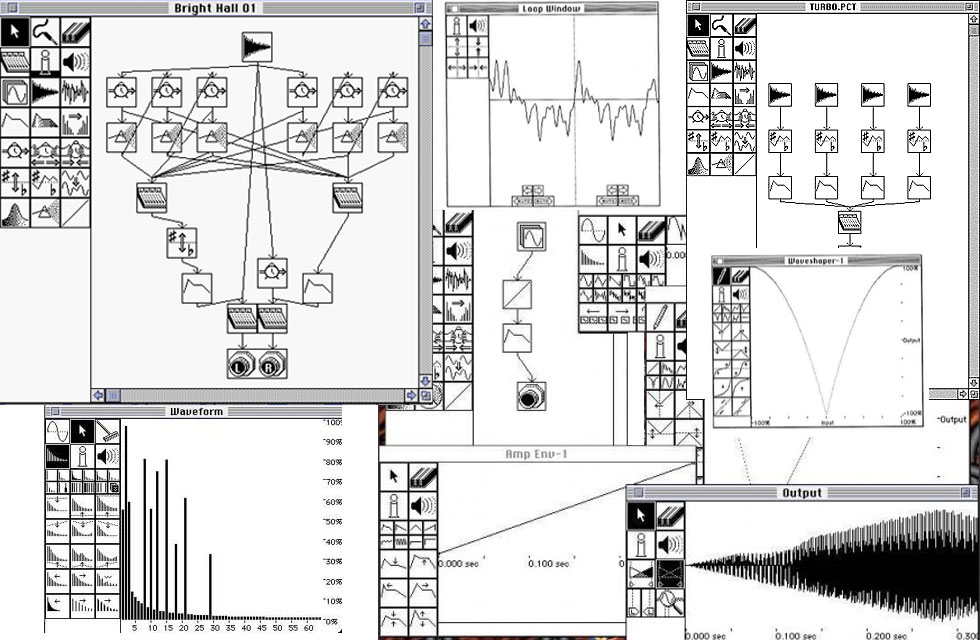
Conversely, Turbo-synth (also by Digidesign) requires no special hardware. This near-modular environment is not real-time (you must render the sound before playback) but it nevertheless achieves some astounding things. Sound sources include AIFF samples, plus additive spectra generated by the program - these can then be processed by noise, a waveshaper, filter, timestretching, delays, a pitchshifter, diffuser, resonator, mixer, modulator, and multi-segment pitch, filter and amplitude envelope generators! It's well worth tinkering with.
Synthesizers & Samplers
The 68000 found it's way into musical instruments too - which is no surprise as the line between general purpose computer and digital synthesizer/sampler has always been kinda hazy!
1986's Fairlight series III featured 14 Megabytes of wave memory and two 68000's (alongside a band of 6809's) running the show. I'd love to sit down with it's FFT resynthesis one day!
There's one more instrument that pushed the 68000 in exciting musical directions - the Ensoniq EPS16+. It's often (alongside the ASR-10) remembered fondly by Hip Hop artists, and these machines do incredibly unique things with samples - even to this day. The 68k is joined by the DOCIII chip (which plays the samples) and the ESP signal processor - for effects.
The ability to step through a sample in user-defined chunks (transwave synthesis) isn't too exotic; tiny chunks leading to wavetable textures, larger ones leading to familiar sample-munging effects. The EPS is chock full of alternative scanning modes though, like LOOPSTART-X (which turns a sample into a digital hard-sync growl) or BIDIRECTIONAL LOOPING (which tends to make wavetable sounds drop an octave and introduce endearing little artifacts when modulated).
Because the 68000 was so well-documented, 3rd parties released their own software for the instrument. The Waveboy series of disks contained new effects algorithms - Resonant Filter, Time-Dicer, Lofi, FM and (somewhat clicky) Granular Processing to name but a few.
I love this architecture - there are 7 such chips in my studio, so here's to the next 45 years, 68k!
Posted by MagicalSynthAdventure an expert in synthesis technology from last Century and Amiga enthusiast.
Get the latest headlines, offers and more in our fantastic sonicstate newsletter - delivered to your in box every week

Get Our Newsletter
More...

And more
 Erica Synths Razornator - Sonic Demo
5 stereo Chromatic resonators in a desktop effect
 3D Design Print Your Own Synth Stands With Loopop
Web app for your custom stands
 SinTH2 60 Voice Monster Polysynth
All digital hardware beast
 Sonic RETROCAST 4 - Robert Henke AKA Monolake
Retro computing live and other topics
 The Bristol Old City Studio - Drop In Tour
We take a tour and find a Polymoog too


