Cool Tech from 1982: The Compact Disc Pt1.
06-Jul-26

|
I think it's natural to be interested in the state of technological progress, the state of the world even, at the time of one's birth. Despite such developments happening on a continuum - a curious effect can appear: We develop a bias towards "our" year as the most inventive, the birth of a modern world, the year the world went from monochrome to colour.
I won't be challenging that bias - I think it's fairly benign as biases go - and well, it's my series of articles, so I'll be writing about all the cool stuff that changed our musical lives in 1982. Let's talk about the Compact Disc.
The Birth of the CD
The Compact Disc (or CD for short!) ushered in a Multimedia revolution. The silver disc offered a huge amount of storage space for the time - 650MB or 74 minutes of digital audio! In a world used to bulky 360KB floppy disks, the CD seemed miraculous, witchcraft even! So impressive was the silver disc's potential that just about everything has been pressed to them over the years: audio, text, graphics (CD+G anyone?), MPEG-1 video and suites of computer programs.

In October 1982, Sony released the CDP-101 Compact Disc player for 168,000yen (approx £1,352 in 2026 UK currency) - interestingly, the world might have gotten CD earlier if collaborator Philips had gotten their way. By 1979 they'd already built a prototype CD player - Pinkeltje - which slightly differed from the final CD standard (known as the Red Book) in a number of ways.
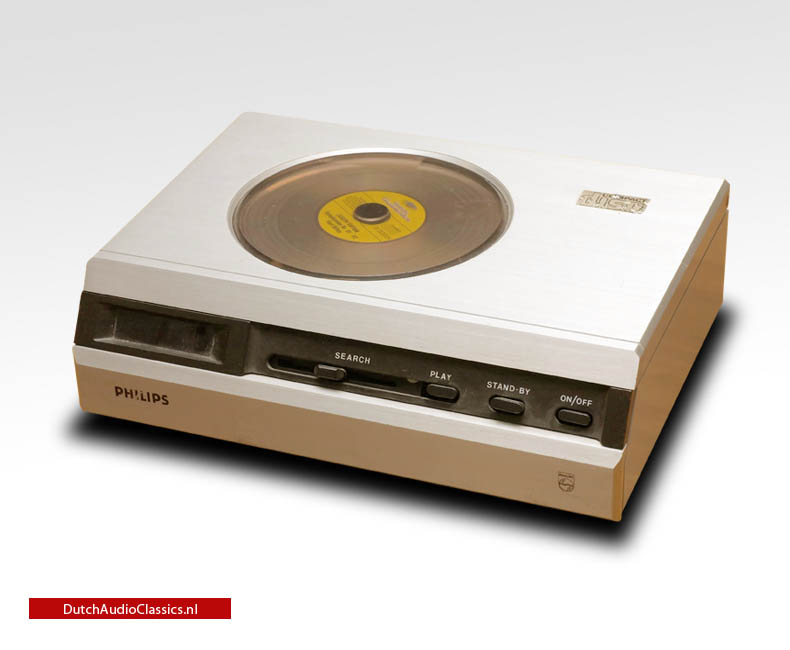
https://www.dutchaudioclassics.nl/philips_pinkeltje_prototype_cdplayer_march_1979_joop_sinjou/
The discs were slightly smaller (11.5cm vs the standard 12cm) and crucially, Philips had decided that 14-bit resolution would suffice for consumer audio - with a fully developed 14-bit DAC (the TDA1540) already in place. Sony disagreed - seeking to future-proof the format. Heitaro Nakajima - Sony's Project Lead, believed that a 16-bit format could one day serve computing as well as audio (14-bit CD ROMs wouldn't align with common 16-bit data structures) and these lengthy discussions undoubtedly had an effect on CD's release date.
By the way, early CD titles included ABBA's The Visitors, Billy Joel's 52nd Street and Richard Strauss's An Alpine Symphony - something for everyone there!
Indestructable?
At the time, much was made of CD's resistance to wear and tear! In a 1981 episode of Tomorrow's World, presenter Kieran Prendiville dragged a stone across one poor disc's surface to demonstrate it's hardiness, and he wasn't the only disc man-handler:
"Consumers who buy CDs tend to become fervent disciples. Senator Barry Goldwater, a jazz fan who bought a Hitachi model last year, demonstrates the durability of CDs to neophytes by tossing the disks across his Washington apartment. He is thinking about buying a CD player for his car." - Time Magazine, 01/07/85
Of course, we're now all too aware of this format's limitations. CD's are subject to disc rot - an oxidisation of the aluminium layer that eventually renders data unreadable, and extreme heat (did you leave your copy of "Chocolate Starfish" on the dash of your Corsa on a blazing hot day again?) can cause the layers to delaminate.
Still, the CD does handle scratches pretty well, due to a smart error-correction algorithm (CIRC). Technology Connections offers an in depth video on the mechanics of playing a CD:
That's it for this time. Next, I'll take a look at how the CD fared as a computer storage medium and then talk about my fond memories of the format; memories I'm sure a few of you will share!
More From: SONY- NAMM 2014: New PCM-D100 Audio Recorder from Sony 04-Feb-14
- Sony SoundForge Pro Available on OS X 09-Oct-12
- Sound Forge On A Mac 14-Sep-12
- Sony Releases Dubstep Loops For Acid Pro 22-May-12
- GadgetShow12: New Balanced Armature In-Ears from Sony 11-Apr-12
Even more news...


