|
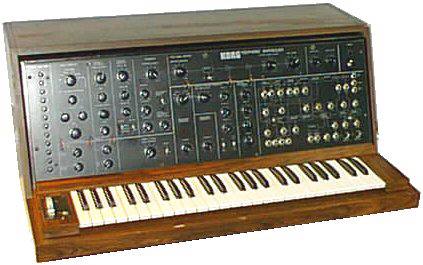
The PS series of polyphonic synthesizers were hands-down the most powerful polyphonic synthesizers at the time(s) of their release. While the PS-3300 might be the ultimate polyphonic synthesizer of all time, the PS-3100 is still more useful, diverse, and powerful than most analog non-microprocessor polyphonics. Yes, the PS-3100 uses divide-down circuitry to arrive at its massive polyphony. Yes, this is a technique that has been used by organs... but the PS-3100 has little in common with the organ beyond this technique. In order to make this device a true polyphonic synthesizer, Korg placed a separate VCF, ENV, and VCA per note... which immediately removes it from any organ similarity, while simultaneously making it one of the few truly polyphonic synthesizers. I'm baffled by the constant "thin" assessment on this review page. The PS-3100 has a very warm, broad sound... it can be deep and dark, or bright and punchy. Yes, it's a one oscillator synthesizer... but having multiple oscillators is no guarantee of a great or thick sound. In my opinion, the great benefit of multilple oscillators is diversity of timbre, more than anything. Layering oscillators can create a thicker sound, but often you're just creating a chorus effect... and to that end, the PS-3100 has a great chorus (which I rarely use, as it makes it sound more like a 1980s era synth). If you cannot make great analog polyphonic sounds without multiple oscillators, well... maybe it's not analog you're really looking for... or, maybe it's not non-microprocessor analog you're looking for. The PS-3100 has a host of great and uncommon functions. The LFO (modulation generator 1) goes up to a frequency of 1k! This is far beyond the frequency range of just about any other synthesizer, which makes it capable of a host of amazing effects... not to mention the diversity of LFO waveforms... including pink AND white noise (although I wish they might have made the noise generator available to the audio path). Possibly the coolest module on the 3100 is the Resonator. The Resonator is basically a 3-band equalizer... except that it is sweepable! This fact transforms it from a basic but useful sound-shaping device to the coolest modulation possible. You can assign MG2 or whatever is patched to control the manner of sweep... whether its a simple triangle-wave modulation, or wheel, or envelope, noise or sample and hold from the patch bay! The modulation routings in combination with the Resonator are one of the amazing strengths of this synth. There is nothing to compare to this rare and awesome analog sound. There is the amplitude modulator... which sounds essentially like a ring modulator. Yes, you can get those clangorous bell-tones, but you can also use it to broaden the sound, or to make high-frequency modulation sounds in the same way you can use the LFO in conjunction with the frequency. Yep, the PS-3100 creates analog FM! The Envelope Modifiers section is a single controller for the Envelope-Generator-Per-Note. This is where you set the basic envelope for the sound. I wish a pot would have been assigned to the Release stage, just like everyone else... BUT... this limitation can be immediately fixed with a single patching in the patch section. Run a patch cable from the patch output of one of the voltage processors into the release patch point, and pow. One of the voltage processors now operates as a release pot (Limiter A acting as fine-tuning, Limiter B acting as coarse). You actually end up with MORE control over the release than if you had a single release knob! So, put your release-stage fears to rest. The General Envelope Generator is a single Envelope Generator you can apply to the sounds in ADDITION to the Envelope-generator-per note... or, you can direct it to control just about EVERYTHING ELSE. It's great for PWM, I've found. Of course, it's a single Envelope, so you run into the fact that added notes to a held chord don't re-trigger it... but who cares. This is only really irritating if that's all you have in the way of envelope control. A neat feature is that you can designate how many notes held will trigger the GEG. This means, for example, you can control which chords get a filter sweep and which don't based upon how many notes are in them. There are so many features I want to list... but this is already an epic! For how cool and versatile everything on this device is... add in the power of the patch bay, and it's all multiplied by an almost infinite degree. I'm sorry to keep using the word diversity, but... that is the strength of the PS-3100. I think many are too used to ROMplers and the like... they don't realize how amazing the capabilities of the PS-3100 are for its time and what it is. Sound... how does it sound? Well, sound is subjective... but I will say this: you could program it all day and still becoming up with patches that surprise you by the end. It can create pretty much any analog sound you can think of, and a lot of sounds you wouldn't expect from analog. It is not simple. It is among the least simple non-fully-modular analog synthesizers. I would say if you're looking for something for techno or any electronic variant that requires MIDI control... or if you're looking for something that "does great leads, pads, and basses..." you're probably not the sort that would enjoy the PS-3100 (not that it doesn't do great leads, pads, and basses...). However, if you're the sort that enjoys analog synthesis, the analog sound, and walls of knobs... you don't get much better than this. At some point, I am going to start posting examples of the PS-3100, to put to rest the notion that it is thin, simple, etc. Oh, and one final thing: the modulation wheel is MADE OF METAL... it is the least flimsy thing I've ever SEEN. It does, however, have an extremely subtle center detente- which is very good because often, due to the various voltage requirements, you need the wheel to start from a fully-down position, and you wouldn't want it landing in a massive detente if that point didn't represent zero. As for the keyboard action: the same as synthesizers everywhere. If you have any questions, please e-mail!
|