|
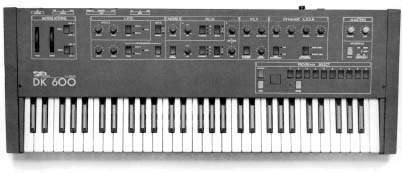
Interesting to read people's comments regarding the Siel DK600 ..... I've had mine from new (serial 367/230). I'm fascinated to read that, from the serial number, mine is a later model, and indeed it has always had the velocity scaling, set midi channel etc features of the later os.
Can anyone confirm that it must have been released in the UK quite late in the day then, because I bought it when they first arrived in these shores. I remember it being touted in the uk music press as the first touch sensitive synth for under £1000 sterling, and shops generally priced it at £999 initially, that's certainly what A1 in Manchester had it for sale at.
I tracked down the cheapest deal offered in the UK when they first arrived, a company called JSG in Bingley, West Yorkshire sold it to me for £835 as I was buying some other gear too. Anyway, I'm just curious as to whether they were sold elsewhere in the world before the UK - maybe the UK still had Opera 6's to sell so shops didn't take the DK600 so soon.
But I definitely bought mine very soon after the first UK press adverts came out, so I'm very surprised to find mine is a later model. I wonder if some components originally manufactured for the Opera 6 were used in early DK600 batches, and whether these first batches were shipped to USA, where most of the comments seem to come from.
I noticed someone mentioned the 'strange' VCF & VCA pedal sockets - well I bought 2 pedals at the same time as the synth, and they are so cool - they have an old fashioned torch bulb in them, and operating the pedal moves a piece of plastic in front of the bulb so that more or less light is detected by the adjacent light sensitive device. It makes for particularly smooth changes in VCF or VCA amount, basically volume and filer cutoff controls on foot pedals.
Mine suffered the leaking battery problem long before the internet could inform me of impending doom, but I never got rid of it and it stood on end as a decoration in my studio for many years. But I'd gigged it for years before that and it was always reliable!
I eventually found James Walker in Stoke On Trent (someone else here mentions him) last year, and got him to repair it for me. It now works a treat ;-) And I got him to wire in a new battery holder that sits remotely from the boards, so no more leak problems, and I can change the battery in the future when I need to (a different battery type - shouldn't leak at all). I'm still amazed that the only problems that he found with the synth were directly related to the leaking battery - some pcb retracking was needed and several chips had to be replaced, but everything else is still fine after all these years, so mine, at least, seems to have been well built.
I wonder how many working ones there are left in the world - only the ones that have found their way to someone who can repair the battery damage and replace the damaged chips I guess. I seriously doubt, from what I've read, that there are any that haven't suffered this problem, and I wonder how many were simply discarded.
I've also got the original manual (yes the one printed on computer paper, along with both Siel Italy and Siel UK Ltd guarantee forms (I never sent them off!).
I have the original cassette of factory sounds, but the sounds do not match the factory sounds list in the manual. A wav file that I downloaded from the net (from the Bang Out Of Order website) does match the factory sound listing. Interestingly, the code on the cassette is 01.0/OP6, which probably indicates that it is the factory sounds of the Opera 6. The cassette itself is labelled SIEL Factory Sounds - it doesn't mention the DK600 on it, but it is definitely the one I got with my DK600. So I'm definitely intrigued by all this early/late os etc info as compared to my knowledge that I bought it when it first came out in the UK, and it came with an Opera 6 factory sounds cassette, which might indicate it is an early one! Maybe early and late os models were built around the same time and it is simply that some were built using leftover Opera 6 control boards hence omni on, no velocity scaling etc, while others had a redesigned DK specific OS board. Anyone able to shed more light on it? Cheers, Nigel PS - I love the sound of it, to me, way better than the Roland and Korg alternatives of the day in the same price bracket - better than a Juno 106, although I reckon the 106 isn't a fair comparison anyway, I remember the main Roland rival at the time in that price braket being the JX3P. And the 3 LFOs thing isn't a gimmick, it's so good ..... LFO's 1 and 2 are operated from one set of controls (depth and speed) but LFO 1 is wired to oscillator 1, while LFO 2 is wired to Oscillator 2. You can have no LFO active, either one active, or both active. Their beauty is in the fact that they are not synced together, so although they are nominally running at the same speed and depth, they drift from each other over time. This causes a more more fluid detuning of the oscillators against each other when affected by the LFOs, IMO making a richer sound overall. And, very unusually for synths of the day, these LFOs 1 & 2 produce sine waves not triangle waves, so their effect is much more smooth too when modulating oscillator pitch. LFO 3, which routes to the filter and/or pulse width modulation, has a choice of triangle or square, but LFOs 1 & 2 are fixed - they only produce sine waves. Although I'd love to have had a second envelope generator, only having one envelope for both Filter and Amplifier was a pain (although IMO more than made up for by the 3x LFO blessing) it's no longer a problem. I simply use the DK600's envelope for controlling the filter and feed the DK600's output into the audio in of my Waldorf Pulse +, which passes the DK's sound through the Pulse's filter and amplifier sections, and, hey presto - I can apply another filter if I want, but I usually just leave ther Pulse's filter fully open and use the Amp Envelope section !!!!!!
|