|
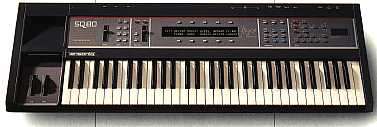
This is my second time around with this synth and it still holds surprises. This a programmer's board and I'll write about it's strenghths and limitations.
As with any synth this deep, you have to get very familiar with it because the sweet spots are harder to find. It's the price you pay for having all this flexability. The best waveforms are the squares, sine, triangle, noise type waves, and the elec. piano. They are great and provide instant gratification. They add weight to patches if you use them on a third osc. I feel the saw wave is very weak but workable. The other waves can sound sort of fizzy and there isn't enough difference between them. I guess it's nice to have them though when you are trying to find the right harmonic to fit your song on, say, pads. I guess the best use for these smaller sounding waves are for the pingy, needle-like sounds of much glitch and IDM music.
The filter is LOVELY at lower rates. It sounds too brittle in it's extreme settings and I don't like it's resonance on most patches so keep that cutoff point low...and it sings for analog type sounds.
Having this many LFOs and envelopes is brilliant, especially when they're applied to the DCAs. I use the LFOs mostly for creating effects like chorus and delays. If you want to use them for normal stuff like vibrato, keep their mod values low as the LFOs can be a little sterile sounding. But like I said, for effects like chorus/delay it can sound similar Ensoniq's DP line of processors! Lush. Using the mod wheel to bring in the effect is best as it does not sound the same as just applying the effect normally within the patch for some reason.
Another strength of the LFOs is applying each one to the oscillators at different waves and rates for pseudo arpeg/bit stream effects 'similar' to the abilities of the old Korg Mono/Poly.
Setting up your patches for velocity and aftertouch can be tricky. To get the full effect (if you want that) of the expression you have to set the value of where ever the mod routing is to zero. There has to be somewhere for the parameter "to go", so to speak. I had a hard time with this at first. This synth can be very expressive this way and the smallest amount of, say, the poly-key pressure, can change/move the sound in drastic ways. Nice. Also, don't forget to experiment with the velocity values within the envelopes, lot's of expression can be had there too.
The SYNC and AM abitlies are interesting and I have accidentally created some sounds that I know I have heard on early Rave tunes. This is where the SQ80 can sound very gritty and computer/bleepy, if that makes sense. These features sound cool when you start tuning the oscillators to 5ths or 3rds, pitting the oscs up against eachother. AM is funny, it doesn't act on the all the waves similarly so just scroll thru the waveforms of the oscs until you feel it happening. You will know it.
It's great that this board doesn't cut off your current sound when you change to a new one. With this little of polyphony it's helpful and I wish more synths did this. Also, in the modes page, the ability to set the patch to run the envelope's full course with a tap of a keystroke has come in handy on certain sounds.
All in all, this synthesizer offers an enormous amount. Due to it's low polyphony it is not a do-all board...but it offers much more than other synth in this price range compared to others of it's day.
|